Showing posts with label Nankeen Night-Heron. Show all posts

Sunday, 6 October 2013

Mungalla Station (Part 2)

Last night at Mungalla Station we spotted the rear ends of several Australian Pratincole disppearing into the distance as the bus past by on its way to the wetlands so we were keen to get back there tonight for a more serious attempt at finding them. Jake, the manager at Mungalla, suggested another location where the pratincoles were more common so we were dropped there for another pre-dinner birding session.

As we arrived, we spotted an Australian Bustard and there were frantic gropings for cameras and opening of windows to get a shot or two as the bird walked past us about 100 metres away but seemingly not particularly concerned about the bus.

Australian Bustard, Mungalla Station Qld

As soon as we arrived at the new location, it was evident that Jake knew his property well as we could see at least 20 pratincoles distributed across the paddocks feeding among the grass. Four of them remained close enough to the bus to tempt us into photographing them but no matter how slowly or stealthily an approach was made, they refused to let us any closer than 40 metres so we all had lots of shots like this heavily cropped example

Australian Pratincole, Mungalla Station Qld

 and all too frequently this was the view we got of them

Australian Pratincole, Mungalla Station Qld

but 5 minutes and two new species photographed was a good start to the evening.

Once again there were lots of waders to be seen at the wetlands but they were too far away for good photographs. One intriguing bird was seen by several of us but remains unidentified. No-one got good shots of it and this is the best I have:

Red-necked Stint, Sharp-tailed Sandpiper + ?, Mungalla Station Qld

I am assuming the bird on the far left is a Red-necked Stint and the three larger birds on the right are Sharp-tailed Sandpipers but the smaller bird on the left remains a mystery. It looked like a Red-necked Stint but was distinctly smaller. Any suggestions are welcome.

Another interesting (but not quite as intriguing) sight was the synchronised feeding of three spoonbills, which is not particularly unusual but there are two Yellow-billed Spoonbill and a Royal Spoonbill here.

Yellow-billed Spoonbill + Royal Spoonbill, Mungalla Station Qld

As we walked back to the bus pick-up location, I couldn't help another landscape shot of this beautiful property.

Mungalla Station, Qld

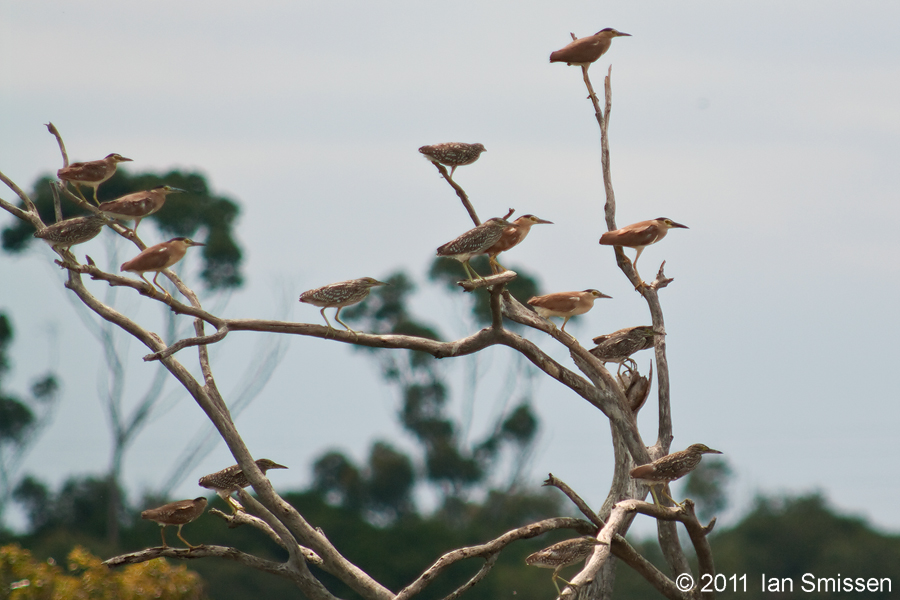
and again, as last night, the Nankeen Night-Herons were flying around their rosting trees, presumably readying themselves for a night out.

Nankeen Night-Heron, Mungalla Station Qld

Saturday, 5 October 2013

Mungalla Station (Part 1)

After a brilliant morning at Tyto Wetlands (see Part 1 and Part 2) and some great afternoon workshops, we gathered at Mungalla Station for some early evening birding and BBQ dinner.

Mungalla Station is a cattle property located approx. 12 km east of Ingham. The property is owned by the Nywaigi Aboriginal Land Corporation and managed by the Mungalla Aboriginal Business Corporation. Their mandate to "...improve the economic and social position of our people..." is being achieved through property management and cultural and eco-tourism.

The wetland on the property is a treasure being brought back to life by careful environmental management.

Mungalla Wetlands

In the 90 minutes we had exploring the wetland, we found a variety of wading birds including Masked Lapwing, Red-necked Stint, Red-kneed and Black-fronted Dotterel, Sharp-tailed Sandpiper, Curlew Sandpiper, Marsh Sandpiper and Latham Snipe. All were too far away for any good photography so I concentrated on the many birds flying overhead.

Brolga, Mungalla Wetlands

Magpie Goose, Mungalla Wetlands

Several small terns were fishing right in front of a group of photographers


but their quick movement and the poor light made it difficult to identify them with any certainty. These are the best photographs I could manage.

Whiskered Tern, Mungalla Station

I am not 100% convinced but the best identification I can come up with is Whiskered Tern. The only alternative is that they are White-winged Black Tern. WWBTs are northern hemisphere summer breeders that migrate to Australia in our spring. Early arrivals may retain some breeding colouration. I am not familiar enough with the changes of these birds as they move into and out of their breeding colouration. These birds have retained the red legs and bill there is no evidence of black plumage so I think it unlikely they are WWBTs.

As the sun was setting we walked back to the designated pick up spot where a flock of Nankeen Night-Herons were roosting.

Nankeen Night-Heron, Mungalla Station
Mungalla Station

Monday, 18 February 2013

Begola Wetlands

Begola Wetlands is a remnant of the once more extensive wetlands that ran behind the dunes of Ocean Grove and Pt Lonsdale to Swan Bay (see map). It contains a shallow lake that dries out in most summers and is a haven for waterbirds that feed in shallow water or mud. The recent hot, dry weather has dried up most of the lake leaving extensive mudbanks that have attracted a large number of birds. 

Begola Wetlands, Ocean Grove

I spent an hour walking around the wetlands this evening as the sun was setting and saw 25 species:
  • Pacific Black Duck
  • Grey Teal
  • Chestnut Teal
  • Australasian Grebe
  • Purple Swamphen
  • Dusky Moorhen
  • Eurasian Coot
  • Australian Spotted Crake
  • Masked Lapwing
  • Nankeen Night-Heron
  • Australian White Ibis
  • Royal Spoonbill
  • Silver Gull
  • Latham's Snipe
  • Black-fronted Dotterel
  • Rock Dove
  • Spotted Dove
  • New Holland Honeyeater
  • Australian Magpie
  • Magpie-lark
  • Willie Wagtail
  • Superb Fairy-wren
  • Common Starling
  • Little Raven
  • Welcome Swallow

I'm not a great list keeper but I cannot remember seeing this many species here in a single visit before. 

With the receding water, most of the birds were in the central part of the lake, 50-100 metres away, so were not the best photographic subjects but I managed to capture a few (mostly cropped quite heavily).

Masked Lapwing, Begola Wetlands, Ocean Grove
Australian Spotted Crake, Begola Wetlands, Ocean Grove
Black-fronted Dotterel, Begola Wetlands, Ocean Grove
Chestnut Teal, Begola Wetlands, Ocean Grove
Grey Teal, Begola Wetlands, Ocean Grove
Nankeen Night-Heron, Begola Wetlands, Ocean Grove
Royal Spoonbill, Begola Wetlands, Ocean Grove

I counted at least 6 Latham's Snipe, all out in the open, feeding and preening on the mudflats. Snipe are usually quite secretive so it was great to see them so clearly and manage to photograph some, albeit from a long distance.

Some were heavily camouflaged among the weeds in the mud

Latham's Snipe, Begola Wetlands, Ocean Grove

Others were up and about, feeding

Latham's Snipe, Begola Wetlands, Ocean Grove

While this one shared a bath with a Chestnut Teal, closely observed by a Dusky Moorhen


Sunday, 18 December 2011

Broad-billed Sandpiper @ WTP

Following recent reports of a Broad-billed Sandpiper at the Western Treatment Plant, I went to have a look for myself. Several reports gave fairly specific location details but I was concerned that this could be a needle in a haystack search with so many other small wading birds at the same location. However, with a little homework (a brief perusal of various guidebooks this morning to familiarise myself with the characteristic features) it turned out to be surprisingly easy to find the one individual among the Curlew Sandpipers, Sharp-tailed Sandpipers and Red-necked Stints at Western Lagoon 4. Even better, it was close-by the best viewing area and all the birds were tolerant of three of us standing and watching, allowing for some decent records shots for this lifer for me.


Broad-billed Sandpiper, Western Treatment Plant

While watching and photographing the birds, I commented to one of the other observers that all I wanted now was for a Curlew Sandpiper to come close enough to get the two birds in the same shot for a side-by-side size comparison. No sooner said...

Broad-billed Sandpiper (L) and Curlew Sandpiper (R), Western Treatment Plant

On the way out, I dropped past Ryan's Swamp to find a large flock of Nankeen Night-Herons (approx. 50 birds roosting in various trees at the north-west end of the swamp).

Nankeen Night-Heron, Western Treatment Plant

On departing the plant, I had just finished locking the gate when a Rufous Songlark landed on a fence and started singing. It was getting quite dark with some threatening clouds overhead but I managed a few shots (albeit with slow shutter speeds and wide open aperture)

Rufous Songlark, Western Treatment Plant

Driving home past Lake Connewarre, I spotted a pair of Brolgas with a half-grown chick in long grass about a hundred metres from the road. I pulled over and leapt from the car with camera in hand in time for one shot of them.

Brolga, Lake Connewarre

One of the adults separated from the others and continued to stay in view for another few minutes.

Brolga, Lake Connewarre

Saturday, 24 September 2011

Long weekend in Central Victoria - Day 2

We started the morning with a quick trip out to some drainage ponds near Woodvale (just north of Eaglehawk - see map) to catch the Red-necked Avocet and we were not disappointed.

Red-necked Avocet, Woodvale

We then drove to the Kamarooka section of the Greater Bendigo National Park entering along Millwood Road from the south. We stopped just past the entrance to the park and immediately heard Rufous Whistler calling. The loud and persistent calls suggested a male but none of us could find one. We did manage to find this female singing her little lungs out. 

Rufous Whistler (female), Kamarooka Section, Greater Bendigo NP

Next stop was further into the park, where we were promised White-fronted and Tawny-crowned Honeyeaters. I had not photographed either species before and, in fact, never seen a Tawny-crowned Honeyeater. Within five minutes of getting out of the car I found a White-fronted Honeyeater perched on a nearby branch, food in its mouth.

White-fronted Honeyeater, Kamarooka Section, Greater Bendigo NP

The Tawny-crowned Honeyeater was proving to be more elusive until one of the group told me they had found one just near where they were parked. Sure enough, while standing right next to the car, this bird flew into a nearby shrub. It was behind several dead branches of another shrub (which totally confuses the auto-focus as it tracks back and forth looking for something to focus on and usually ends up on a stick in the foreground) so I switched to manual focus and managed to get this image - backlit and blurry foreground but still pleasing

Tawny-crowned Honeyeater, Kamarooka Section, Greater Bendigo National Park

The bird then moved and perched on another branch a few metres away - still backlit but clear view.

Tawny-crowned Honeyeater, Kamarooka Section, Greater Bendigo NP

The bird was now getting the hang of this photo-model business and it moved a few metres again, still back and sidelit but a beautiful background of purple wildflowers.

Tawny-crowned Honeyeater, Kamarooka Section, Greater Bendigo NP

It then disappeared into a dense patch of shrubs right in front of us. This behaviour is typical of nesting birds, where they don't go straight into the nest but flit from branch to branch in a different pattern each time they enter and leave a nest. So, to avoid disturbing the nest any further, I was just moving away when this bird came from the same patch (may be the same bird or its mate) and stopped just in front of me just as a cloud came across the sun, providing a detailed view of this species' beautiful plumage.

Tawny-crowned Honeyeater, Kamarooka Section, Greater Bendigo NP

All of these photographs were taken within a 10 minute period. I can't remember another occasion where I got so many different views of the same bird at one location in such a short time AND this was the first Tawny-crowned I have ever seen (very happy!)

We moved off to another location for a lunch by an old eucalyptus oil distillery. A walk around the distillery dams and lots of the common bush birds were seen and heard but the highlight of the afternoon was a juvenile Nankeen Night-Heron found at another small dam just down the track

Nankeen Night-Heron (juvenile), Kamarooka Section, Greater Bendigo NP

A brilliant day out in the bush greatly helped by some local knowledge (thanks Murray!)

for more:
The night before

Birding and Natural History Blogs - Australia

Birding Blogs - Worldwide