Showing posts with label Australian Pied Oystercatcher. Show all posts

Sunday, 23 October 2016

A bit of birding in lieu of a pelagic trip

The pelagic birding trip we were booked on today from Port Fairy was postponed due to the weather so I dropped into a few places on the way home to see what I could find.

First stop was the wetlands at the start of the Port Fairy Rail Trail. Several Golden-headed Cisticola were calling from the reeds but they stayed in the centre of the wetland so I couldn't get any closeup shots. This was the best I could do.

Golden-Headed Cisticola, Port Fairy Rail Trail
Pentax K-1, Sigma 300mm f/2.8 (x1.4 adapter), ISO 800, f/4, 1/400
Golden-Headed Cisticola, Port Fairy Rail Trail
Pentax K-1, Sigma 300mm f/2.8 (x1.4 adapter), ISO 800, f/4, 1/500

Three Common Greenshank were feeding along the edge of the Moyne River but only one was close enough for a half decent shot.

Common Greenshank, Moyne River, Port Fairy
Pentax K-1, Sigma 300mm f/2.8 (x1.4 adapter), ISO 800, f/4, 1/1000

I tried Belfast Beach but there were people and dogs along the beach so I didn't bother looking for any birds and headed for Killarney Beach, where I found three of my fellow pelagic-trip refugees and we took a walk along the western end of the beach. We spotted six Hooded Plovers but decided not to approach them too closely as they were fairly skittish. A pair of Kelp Gulls was hanging around on the shore and this one stayed still long enough for a long-distance shot.

Kelp Gull, Killarney Beach
Pentax K-1, Sigma 300mm f/2.8 (x1.4 adapter), ISO 400, f/5.6, 1/2000

There were also Sooty Oystercatchers and Australian Pied Oystercatchers flying around.

Sooty Oystercatcher, Killarney Beach
Pentax K-1, Sigma 300mm f/2.8 (x1.4 adapter), ISO 400, f/8, 1/2000
Australian Pied Oystercatcher, Killarney Beach
Pentax K-1, Sigma 300mm f/2.8 (x1.4 adapter), ISO 400, f/8, 1/500
Australian Pied Oystercatcher, Killarney Beach
Pentax K-1, Sigma 300mm f/2.8 (x1.4 adapter), ISO 400, f/8, 1/1250

Lunchtime was beckoning so I grabbed take-away in Warrnambool and went to Thunder Point to eat and watch the avian passers-by. These two Little Ravens sat right next to the car allowing me this shot out of the window.

Little Raven, Thunder Point, Warrnambool
Pentax K-1, Sigma 300mm f/2.8 (x1.4 adapter), ISO 400, f/11, 1/250

The final stop before heading for home was a quick drop-in to Lake Purrumbete just outside of Camperdown. There was very little bird activity on the lake but this Little Pied Cormorant posed for a few shots on a fence post in the middle of a flooded paddock - again shot out of the car window.

Little Pied Cormorant, near Lake Purrumbete
Pentax K-1, Sigma 300mm f/2.8 (x1.4 adapter), ISO 400, f/5.6, 1/2500

Monday, 9 June 2014

A Long Weekend in SW Victoria: Part 4. Shore birds

Driving home from Cape Bridgewater today, we decided to stop at some locations that we'd never visited before and we were rewarded with some great shore bird spotting and photography.

Shelly Beach (on Bridgewater Bay)
This beach is accessible from a short track off the main Bridgewater Road opposite the intersection with Bridgewater Lakes Road.

Shelly Beach, Bridgewater Bay

The highlight here was a pair of Australian Pied Oystercatchers that turned on a great show:

First chasing each other around in circles with one bird latched on to the scapular feathers of the other

Australian Pied Oystercatcher, Shelly Beach, Bridgewater Bay

then taking off in flight,

Australian Pied Oystercatcher, Shelly Beach, Bridgewater Bay

one landing again just in front of me to pose for a portrait

Australian Pied Oystercatcher, Shelly Beach, Bridgewater Bay

The other wandering off purposefully down the beach in the other direction

Australian Pied Oystercatcher, Shelly Beach, Bridgewater Bay

Before flying back,

Australian Pied Oystercatcher, Shelly Beach, Bridgewater Bay

landing on rocks close-by and calling loudly.

Australian Pied Oystercatcher, Shelly Beach, Bridgewater Bay

Mouth of the Fitzroy River
The Fitzroy River drains into Portland Bay a few km SE of Tyrendarra. Access is via Thomsons Road. There's a car park with boat ramp and picnic tables at the end of Thomsons Road but you can continue on past the car park driving along the firm sand bank of the river estuary stopping a hundred metres or so short of the river mouth and beach.

As we walked out onto the beach we spotted a solo Hooded Plover on the water's edge among some washed up kelp.

Hooded Plover, Fitzroy River Mouth

I managed to get a little closer by staying low and crawling slowly while the bird was feeding, stopping every time it looked up. This was as close as I was willing to get so not to scare the bird away.

Hooded Plover, Fitzroy River Mouth

While there I also spotted several Double-banded Plover

Double-banded Plover Fitzroy River Mouth

including this one just starting to develop breeding plumage.

Double-banded Plover Fitzroy River Mouth

Belfast Beach
A stretch of beach due south of Tower Hill, about half way between Warrnambool and Port Fairy, can be accessed from Gorman's Road. If you drive as far as you can there's a small car park with a short sand track to the beach. Immediately we got onto the beach we spotted Red-capped Plovers sheltering in tiny sand scrapes at the lee side of the sand ridge along the beach.

Red-capped Plover (male), Belfast Beach

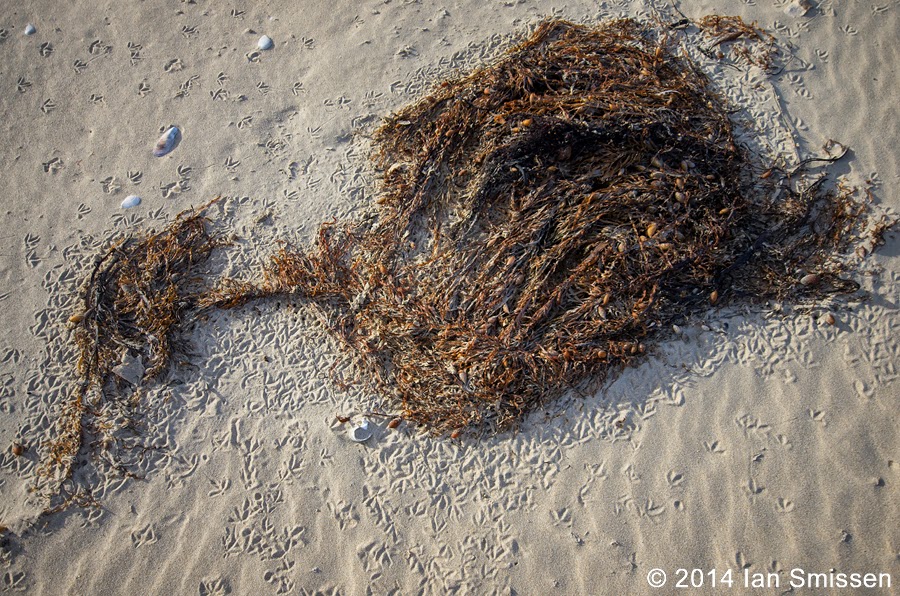
I gave them a wide berth and headed over the ridge towards the sea. Closer to the water's edge, each small pile of kelp was surrounded by footprints where small wading birds had been feeding on the collection of invertebrates that make their home in the kelp.


I spotted several female Red-capped Plovers feeding along the water's edge so I crouched down and crept as close as I thought I could get without disturbing the birds.

Red-capped Plover (female), Belfast Beach

It's possible to get quite close to shore birds, while they are concentrating on feeding, providing you stay low. It helps having dunes in the background so your outline doesn't break the horizon. I tend to sit/kneel and wait for a while so I can see what the birds are doing and let them get used to me. I then crawl up on my knees leaving behind a turtle track...

Photographing Plovers, Belfast Beach
Photo courtesy of Joanne Smissen

...and then wait for the birds to come closer to me.

Red-capped Plover (female), Belfast Beach

It helps if the tide is coming in as most wading birds feed along the water's edge and the incoming tide will bring them closer to you.

Red-capped Plover (female), Belfast Beach

...but sometimes, they look straight down the barrel at you...

Red-capped Plover (female), Belfast Beach

As the waves recede, you can get some nice reflections.

Red-capped Plover (female), Belfast Beach
Red-capped Plover (male), Belfast Beach

A handful of Red-necked Stints were also feeding along the beach, having obviously opted to brave the Victorian winter in preference to the return flight to Siberia.

Red-necked Stint, Belfast Beach

A pair of Double-banded Plovers marched by

Double-banded Plover, Belfast Beach

and, as we were leaving, we found a solo juvenile Hooded Plover on the edge of the lagoon.

Hooded Plover (juvenile), Belfast Beach

The rest of the weekend:
Part 1. Cape Nelson
Part 2. Sunrise at Bridgewater Bay
Part 3. Lower Glenelg National Park

Sunday, 11 May 2014

The Coorong at Goolwa

The Coorong is one my favourite places in South Australia but I'd never visited the Goolwa end until today. So, part tourist and part birder, I drove to Goolwa following a great morning at the mouth of the Onkaparinga River (see previous posts: Reflections on the Onkaparinga River and Hanging at the Beach).

Goolwa is located at the 'armpit' of the Fleurieu Peninsula (see map) and is home to the Barrage and last lock on the Murray River (there is a bird in this shot!)

Murray River Barrage, Goolwa SA

The Coorong is the system of estuarine lakes, islands and the sand dune spits that hold back the Southern Ocean for more than 100 km between Kingston and Goolwa.

Coorong National Park starts downstream of the Murray River Barrage

As I was still an 8 hour drive from home, I didn't have time to search for many birds but did manage to find an interesting collection making the most of the old fence posts at Beacon 19 Boat Ramp. As I drove into the car park at the ramp, a pelican and this Silver Gull were jostling for the roost on the last fence post. I'm not sure how the gull managed to displace the pelican and I wasn't quick enough to get a photograph of the battle but I did capture the smug victor (OK so just a little anthropomorphising...sorry).

Silver Gull, Coorong National Park, Goolwa, SA

This Crested Tern remained, unperturbed, only a few metres away on the next post.

Crested Tern, Coorong NP, Goolwa, SA

The Welcome Swallows were particularly tame, allowing me to get very close. As the light was getting quite dull, I tried fill flash for a few shots.

Welcome Swallow, Coorong National Park, Goolwa, SA

The 'technical' mouth of the Murray River is a break through the dune barrier approximately 10 km east of Goolwa and can only be reached by driving along the beach. As I was by myself and hadn't brought any sand recovery gear, I was reluctant to do the drive this time so opted to take the view of the mouth from Hindmarsh Island.

Mouth of the Murray River, Coorong National Park, Goolwa, SA

By now the weather was turning for the worse with a strong westerly wind and an approaching storm. The birdlife on the beach in front of the lookout was sparse (I suspect the avian locals were more sensible than the tourists) but there were a few Australian Pied Oystercatchers getting buffeted by the wind blowing down the sand banks.

Australian Pied Oystercatcher, Coorong NP, Hindmarsh Island, SA

Saturday, 17 August 2013

A day at Phillip Island - Part 3 Rhyll

After stops at Fisher's Wetland and The Nobbies and Swan Lake, we headed for Rhyll on the NE 'corner' of Phillip Island (see map). Rhyll is a great place for birding. At low tide in spring and summer thousands of birds (wading birds, ibis, herons) feed on the mudflats at 'The Nits' (in the entrance to Rhyll Inlet) and in Swan Bay. The sandier shore along Beach Road between the sailing club and the boat ramp often provides good views of gulls, terns, cormorants, pelicans, herons and oystercatchers.

We got there today on a rising tide so decided not to walk around to The Nits but were treated to some great views of oystercatchers.


Australian Pied Oystercatcher, Rhyll, Phillip Island

A small flock (I can't bring myself to use 'dread', the generally accepted collective noun for terns) of Crested Terns sat preening on the sandy shore near the boat ramp. There were various stages of advancement towards breeding plumage on show and all displayed their characteristic crest. Interestingly, most were banded.

Crested Tern, Rhyll, Phillip Island

Conservation Hill overlooks Rhyll Inlet and is often a good place for birding with a variety of habitats: coastal woodland, farmland, swamp, mudflats and mangroves all close by. We got there in the late afternoon and there was not much bird activity (probably due to the cold and windy weather) but it did provide the opportunity to see several Black Wallabies.

Black Wallaby, Conservation Hill, Rhyll, Phillip Island

Part 1 Fisher's Wetland
Part 2 The Nobbies and Swan Lake

Birding and Natural History Blogs - Australia

Birding Blogs - Worldwide