Urvina Bay (aka Urbina Bay - the two spellings seem to be used interchangeably and I cannot find a definitive answer on which is correct) on Isla Isabela is the most reliable place for seeing Galápagos Tortoises outside of the breeding centres in Isla Santa Cruz and Isla San Cristobal. It also has some of the largest land iguanas on the islands so we were eagerly awaiting this walk. It's a wet landing on a steep beach but we managed it without any mishaps. The walk is a 1.9 km loop with an alternative shorter loop of 1 km. It turned out that there was so much happening in the first few hundred metres that we never made it to the longer loop.
The action started right out of the boat. This hawk flew directly over me while I was putting my shoes on. It pays to be prepared. I had seen two hawks flying around the other end of the beach, so before doing anything else I pulled the camera out of the backpack and attached the 300mm lens...just in case. I took this shot lying on my back on the beach.
 |
Galápagos Hawk, Urvina Bay, Isla Isabela, Galápagos
Pentax K-3, Sigma 300mm f/2.8, ISO 800, f/6.3, 1/400 |
Mockingbirds perched on dead branches right near the beginning of the track.
 |
Galápagos Mockingbird, Urvina Bay, Isla Isabela, Galápagos
Pentax K-3, Sigma 300mm f/2.8, ISO 800, f/6.3, 1/400 |
 |
Galápagos Mockingbird, Urvina Bay, Isla Isabela, Galápagos
Pentax K-3, Sigma 300mm f/2.8, ISO 800, f/4.5, 1/800 |
Finches were flitting between the thorn trees and the track. It was an ongoing struggle to try and identify the finches as we spotted them throughout the islands. They were frequently a long way away and moving. The most common species at many locations is the Medium Ground Finch, which is 'usefully' described in one field guide as '...intermediate in size between Large and Small Ground Finches...[and] the beak size varies considerably'. Based on comparisons with field guide photographs, and reliable advice from the locals, best guess is that these are all
Medium Ground Finches.
 |
Medium Ground Finch, Urvina Bay, Isla Isabela, Galápagos
Pentax K-3, Sigma 300mm f/2.8, ISO 800, f/4.5, 1/200 |
 |
Medium Ground Finch, Urvina Bay, Isla Isabela, Galápagos
Pentax K-3, Sigma 300mm f/2.8 (x2 adapter), ISO 800, f/9, 1/400 |
 |
Medium Ground Finch, Urvina Bay, Isla Isabela, Galápagos
Pentax K-3, Sigma 300mm f/2.8 (x2 adapter), ISO 2000, f/9, 1/100 |
 |
Medium Ground Finch, Urvina Bay, Isla Isabela, Galápagos
Pentax K-3, Sigma 300mm f/2.8 (x2 adapter), ISO 2000, f/9, 1/200 |
I spent a lot of time debating with myself as to whether I should bring a tripod on this trip (more on this in an upcoming post on travel and photographic notes) but I am glad I did as these shots would have been next to impossible without one.
 |
Me photographing finches, Urvina Bay, Isla Isabela, Galápagos
Photograph courtesy of Joanne Smissen |
A hermit crab wandered across the track and stopped on some lava long enough for me to capture this shot.
 |
Galápagos Hermit Crab, Urvina Bay, Isla Isabela, Galápagos
Pentax K-3, Tamron 70-200mm f/2.8 @ 140mm, ISO 2000, f/8, 1/125 |
There was great excitement when we came across our first tortoise. There are somewhere between 12 and 15 'races' of Galápagos Tortoise that have been described (depending on whose taxonomy you read) and at least 4 of these are extinct. The
IUCN currently recognises 12 subspecies of the single species
Chelonoidis nigra; other authorities would like to elevate each race to a species of its own. Regardless (and this after all is a purely esoteric argument when you are in the field), the races are easily defined by the island from which they come, and in the case of Isla Isabela, each of the five large shield volcanoes is home to a different race with the bare lava flows between them isolating the populations from each other. As Urvina Bay is at the foot of Volcán Alcedo, we know that this individual is of the race
vandenburgi (and it has the characteristic shell shape and scute structure of this race).
This large adult lumbered across the track still chewing the vegetation it had been feeding on when we arrived.
 |
Galápagos Tortoise, Urvina Bay, Isla Isabela, Galápagos
Pentax K-3, Tamron 70-200mm f/2.8 @ 180mm, ISO 2000, f/5.6, 1/4000 |
We were hopeful that it would obey the sign...
 |
Galápagos Tortoise, Urvina Bay, Isla Isabela, Galápagos
Pentax K-3, Tamron 70-200mm f/2.8 @ 180mm, ISO 400, f/8, 1/400 |
but apparently tortoises cannot read
 |
Galápagos Tortoise, Urvina Bay, Isla Isabela, Galápagos
Pentax K-3, Tamron 70-200mm f/2.8 @ 107.5mm, ISO 400, f/8, 1/500 |
or they realise that the signs are there to prevent the tourists from following them...this one trundled off into the grassy field
 |
Galápagos Tortoise, Urvina Bay, Isla Isabela, Galápagos
Pentax K-3, Tamron 70-200mm f/2.8 @ 70mm, ISO 400, f/8, 1/500 |
and continued with its breakfast.
 |
Galápagos Tortoise, Urvina Bay, Isla Isabela, Galápagos
Pentax K-3, Tamron 70-200mm f/2.8 @ 122.5mm, ISO 400, f/8, 1/640 |
We found a pair of land iguanas in a burrow a few metres up the track and decided to wait to see if they would come out while we watched the tortoise feeding. 15-20 minutes later, the tortoise wandered further away and with no sign of action in the burrow, we headed further along the track, soon discovering this iguana sunning herself.
 |
Galápagos Land Iguana, Urvina Bay, Isla Isabela, Galápagos
Pentax K-3, Tamron 70-200mm f/2.8 @ 200 mm, ISO 800, f/5.6, 1/400 |
She was to be the centre of attention for the next 30 minutes as each person moved around selecting suitable photographic positions at a safe distance so not to disturb her.
 |
Jo photographing Galápagos Land Iguana, Urvina Bay, Isla Isabela, Galápagos
Pentax K-3, Tamron 70-200mm f/2.8 @ 200mm, ISO 400, f/5.6, 1/320 |
The iguana proved to be a cooperative model allowing us all to get a variety of shots.
 |
Galápagos Land Iguana, Urvina Bay, Isla Isabela, Galápagos
Pentax K-3, Tamron 70-200mm f/2.8 @ 200mm, ISO 400, f/5.6, 1/400 |
 |
Galápagos Land Iguana, Urvina Bay, Isla Isabela, Galápagos
Pentax K-3, Tamron 70-200mm f/2.8 @ 122.5mm, ISO 800, f/5.6, 1/3200 |
 |
Galápagos Land Iguana, Urvina Bay, Isla Isabela, Galápagos
Pentax K-3, Tamron 70-200mm f/2.8 @ 170mm, ISO 400, f/16, 1/200 |
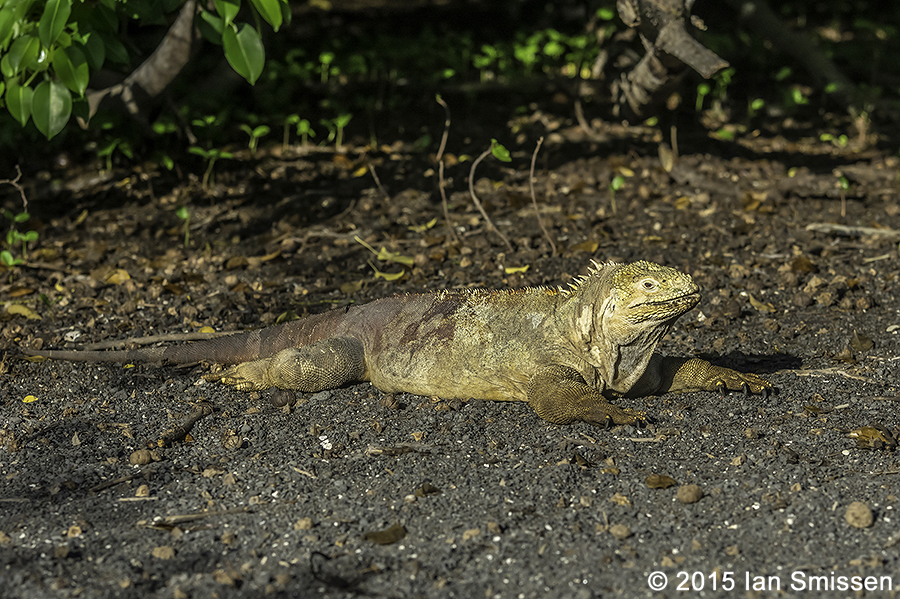
She only moved away when challenged by another iguana. We waited around to see if there would be an altercation but there was nothing more than a few head nods before the challenger wandered off into the bush and the original iguana lay down in the shade. So, we move a little further along the track and found an even larger (probably male) iguana.
 |
Galápagos Land Iguana, Urvina Bay, Isla Isabela, Galápagos
Pentax K-3, Sigma 300mm f/2.8, ISO 400, f/8, 1/400 |
 |
Galápagos Land Iguana, Urvina Bay, Isla Isabela, Galápagos
Pentax K-3, Tamron 70-200mm f/2.8 @ 122.5mm, ISO 400, f/8, 1/400 |
We left him to rest in the sun and continued on the short version of the track, choosing to loop back to the first location to see if there was any action back where we had found the tortoise. We found a tortoise on the track right next to the now empty burrow. We could not determine if this was the same tortoise we had found earlier but it hung around on the track allowing some close-up shots.
 |
Galápagos Tortoise, Urvina Bay, Isla Isabela, Galápagos
Pentax K-3, Tamron 70-200mm f/2.8 @ 180mm, ISO 400, f/5.6, 1/200 |
Hollywood legend has it that the face of ET was inspired by the Galápagos Tortoise...I don't know if this is apocryphal but when you see them like this it makes sense...
 |
Galápagos Tortoise, Urvina Bay, Isla Isabela, Galápagos
Pentax K-3, Tamron 70-200mm f/2.8 @ 200mm, ISO 1000, f/8, 1/180 |
As we were about to leave, another large male iguana came walking down the track (both the tortoises and iguanas seem to make good use of these tracks for basking in the sun and moving about unhindered by vegetation - it is nice of the parks to provide these facilities for the wildlife)
 |
Galápagos Land Iguana, Urvina Bay, Isla Isabela, Galápagos
Pentax K-3, Tamron 70-200mm f/2.8 @ 180mm, ISO 1000, f/8, 1/2000 |
and posed for a few portraits.
 |
Galápagos Land Iguana, Urvina Bay, Isla Isabela, Galápagos
Pentax K-3, Tamron 70-200mm f/2.8 @ 200mm, ISO 400, f/11, 1/500 |
It is a sobering experience to lie on your belly in the gravel and stare (down a camera lens) into the eye of an animal that is so comfortable in its own existence and so aware of but unconcerned by your presence.
I spotted a couple of irresistible flowers on the way back down the track. I enjoy shooting flowers but they have their own challenges that require more time than we had on these excursions but these two were camera high, right on the track.
 |
Darwin's Cotton, Urvina Bay, Isla Isabela, Galápagos
Pentax K-3, Tamron 70-200mm f/2.8 @ 115mm, ISO 1000, f/11, 1/1600 |
 |
Yellow Cordia, Urvina Bay, Isla Isabela, Galápagos
Pentax K-3, Tamron 70-200mm f/2.8 @ 180mm, ISO 2000, f/9, 1/250 |
By the time we got back to the beach, the lagoon behind the dunes had filled up with the incoming tide so it was off with the shoes and barefoot for the rest of the way.