Showing posts with label Australasian Gannet. Show all posts

Saturday, 30 April 2016

Muriwai Gannet Colony (New Zealand)

I was working in Auckland yesterday so decided to stay for the weekend and visit the Muriwai Gannet Colony and Miranda Shorebird Centre, both less than an hour's drive from central Auckland.

Muriwai is one of the black sand beaches on the west coast of the North Island of New Zealand (see map).

Muriwai Beach, North Island New Zealand
Pentax K-3, Sigma 10-20mm f/4-5.6 @ 16mm, ISO 400, f/8, 1/125

It is the home of a large colony of Australasian Gannets, only a few hundred metres easy walk from the car park at the beach. About 1200 pairs of gannets breed here over summer but by this time of the year there are very few birds resident in the colony.

Muriwai Gannet Colony, North Island New Zealand
Pentax K-3, Sigma 10-20mm f/4-5.6 @ 10mm, ISO 800, f/8, 1/1000

Muriwai Gannet Colony, North Island New Zealand
Pentax K-3, Pentax 16-50mm f/2.8 @ 28mm, ISO 400, f/8, 1/250

However, there were still a few remaining, some with juveniles still yet to fledge (and, unfortunately, a few recently dead juveniles)

Australasian Gannet, Muriwai Gannet Colony, New Zealand
Pentax K-3, Sigma 300mm f/2.8 (+1.4x adaptor), ISO 400, f/5.6, 1/800
Australasian Gannet, Muriwai Gannet Colony, New Zealand
Pentax K-3, Tamron 70-200mm f/2.8 @ 200mm, ISO 400, f/5.6, 1/2000

and enough adults flying around to provide some in flight targets

Australasian Gannet, Muriwai Gannet Colony, New Zealand
Pentax K-3, Sigma 300mm f/2.8 (+1.4x adaptor), ISO 400, f/5.6, 1/1000
Australasian Gannet, Muriwai Gannet Colony, New Zealand
Pentax K-3, Sigma 300mm f/2.8 (+1.4x adaptor), ISO 400, f/5.6, 1/640
Australasian Gannet, Muriwai Gannet Colony, New Zealand
Pentax K-3, Sigma 300mm f/2.8 (+1.4x adaptor), ISO 400, f/5.6, 1/1250
Australasian Gannet, Muriwai Gannet Colony, New Zealand
Pentax K-3, Tamron 70-200mm f/2.8 @130mm, ISO 400, f/4, 1/2000

as well as some shenanigans on the ground.

Australasian Gannet, Muriwai Gannet Colony, New Zealand
Pentax K-3, Tamron 70-200mm f/2.8 @ 200mm, ISO 400, f/4, 1/2000

I found one 'outsider' among the roosting gannets.

Brown Booby (immature) + Australasian Gannets, Muriwai Gannet Colony, New Zealand
Pentax K-3, Tamron 70-200mm f/2.8 @200mm, ISO 400, f/4, 1/1600
Brown Booby (immature), Muriwai Gannet Colony, New Zealand
Pentax K-3, Sigma 300mm f/2.8 (+1.4x adaptor), ISO 400, f/5.6, 1/500

and I managed to get one half decent shot of it as it flew away (unfortunately I had the 70-200mm zoom attached to the camera and no time to swap over to a longer lens).

Brown Booby (immature), Muriwai Gannet Colony, New Zealand
Pentax K-3, Tamron 70-200mm f/2.8 @200mm, ISO 400, f/4, 1/2500

still to come...the search for Waybill at the Miranda Shorebird Centre.

Saturday, 17 May 2014

Point Nepean National Park

As I was going to have time before the last ferry on my way home from the Birdlife Melbourne Photography Group day out on Mornington Peninsula, I decide to do a quick reconnaisance into Point Nepean National Park to check it out as a location for a future birding trip. This National Park encompasses the old quarantine station and military fortifications on Point Nepean (see National Park website) as well as some great remnant coastal scrub and relatively unspoiled beaches.

I drove through to Gunnery Cottage (as far as you can drive your own car--any further is on foot, bike or pay for the shuttle bus)--and took the 400m Walter Pisterman Walk to Observatory Point, on the way spotting a flock of Brown Thornbills doing their last minute feeding. Again, low light made photography difficult but I managed to get one shot with flash that captured most of a bird.

Brown Thornbill,
Walter Wisterman Walk, Point Nepean National Park

I arrived at Observatory Point in time to catch the last rays of sunshine peaking through the clouds over Port Phillip Heads.

Sunset over Port Phillip Heads
Observatory Point, Point Nepean National Park

Observatory Point is the location of the ruined Cattle Jetty.

Observatory Point, Point Nepean National Park

I spotted three Pacific Gulls circling around a spot a few hundred metres offshore. On closer inspection, they were harassing a fur seal that had captured (what I subsequently--see below--found out to be) a squid.

Pacific Gull and Australian Fur Seal
from Observatory Point, Point Nepean National Park

One of the birds managed to get hold of the remnants of the seal's meal and bring it to shore.
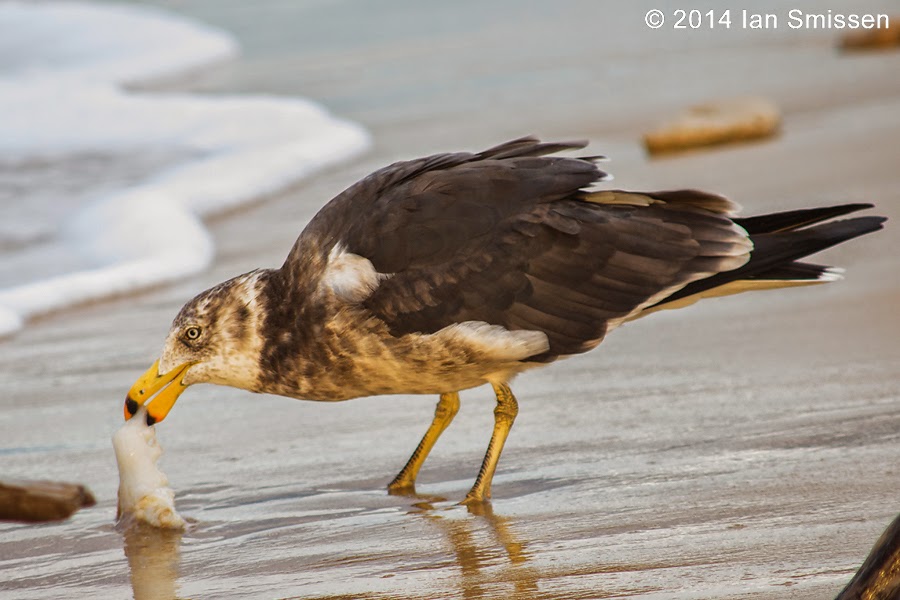
Pacific Gull (immature)
Observatory Point, Point Nepean National Park

After several unsuccessful attempts to swallow the morsel whole and an equally unsuccessful attempt to tear it apart, the bird abandoned it and flew away to land on the other side of me giving some interesting silhouette shots as the sunset in the background. (In the meantime, I managed to check out the abandoned meal and it was what was left of a squid)

Pacific Gull (immature)
Observatory Point, Point Nepean National Park

The gull eventually took off and circled around overhead for a few minutes giving me time to change the camera settings to try for a proper silhouette (helped a little by Photoshop later)

Pacific Gull
Observatory Point, Point Nepean National Park
and to top off the birds in flight, an Australasian Gannet and squadron of Australian Pelicans did a last minute fly-by/over.

Australasian Gannet
Observatory Point, Point Nepean National Park
Australian Pelican
Observatory Point, Point Nepean National Park

By the time I reached the ferry terminal in Sorrento, the sun was well and truly set but I couldn't resist trying to get these two Silver Gulls standing on the pier railing.

Silver Gull (adult on left, immature or right), Sorrento Pier

and one more with flash, just to see if I could get anything useful...I'm not sure, I'll leave it to the readers to judge...

Silver Gull (adult on left, immature or right), Sorrento Pier

Sunday, 1 September 2013

Seabirds in flight at Point Impossible

On the way home from the Western Treatment Plant, I stopped at Point Impossible to see if there were any waders at the mouth of Thompson Creek.

There was a plethora of people walking, fishing, playing with dogs and engaged in soccer and frisbee so there was very little in the way of birds on the beach other than the usual Silver Gulls and Pacific Gulls dodging soccer balls and dogs but generally undisturbed by the human activity. There were, though, several birds flying and fishing around the mouth of the creek.

Pacific Gull, Point Impossible
Caspian Tern, Point Impossible
Australasian Gannet, Point Impossible

I didn't quite manage to get the point of contact with the water but did get a couple of shots of the start of a dive.

Australasian Gannet, Point Impossible

Wednesday, 25 April 2012

Portland Seabirds

Having revised my plans for an extended ANZAC day long weekend due to family commitments and abandoned the idea of a shortened camping trip due to the weather, I decided to make the most of the cold, wet and windy conditions by travelling to Portland to check out the seabirds from Cape Nelson and Cape Bridgewater.


The lookout next to the Cape Nelson Lighthouse offers good viewing of a variety of seabirds that often come close to the cliffs. The Australasian Gannet is the most common bird seen around this coast (other than the ubiquitous Silver Gull) due to breeding colonies nearby.

Australasian Gannet, Cape Nelson

It is also common to see several species of albatross, particularly after storms.

Black-browed Albatross, Cape Nelson

There was not much else on offer during the hour I spent here this morning so, with a storm approaching

Cape Nelson

I headed back for the car to wait out the weather at Cape Bridgewater. First stop was the Petrified Forest and Blowholes lookout

Petrified Forest, Cape Bridgewater
Blowholes, Cape Bridgewater

where there was a veritable hive of avian activity with several clusters of birds fishing offshore


and a passing parade of birds flying past approx. 200-300 metres offshore--not great for photography but close enough to be able to identify species (mostly)

Black-browed Albatross, Cape Bridgewater
Shy Albatross, Cape Bridgewater
Australasian Gannet, Cape Bridgewater

I say "mostly" because there were a few species that, at this distance, were hard to identify with confidence

I could identify three species of shearwaters: Short-tailed, Fluttering and Hutton's with careful examination of underbody and underwing colouration using binoculars but at this distance and viewed mostly from above, it's difficult to tell which is which in photographs. I am fairly confident that these two were Short-tailed Shearwaters based on their dark colouration under the wings and body (seen in other photos in the same sequence)


Short-tailed Shearwater, Cape Bridgewater

Similarly, this juvenile Giant-Petrel is difficult to identify to species without closer examination of the bill colouration


Giant-Petrel, Cape Bridgewater

and even 4x magnification of the original image does not really help much, although I would lean towards Southern Giant-Petrel as the tip of the bill looks closer to greenish than dark pink of the Northern species.


However, the following bird is was a complete mystery to me

Kelp Gull (3rd year immature?), Cape Bridgewater

UPDATE
Thanks to all who have advised that this bird is an immature Kelp Gull - much appreciated. A few people have asked to see more. Unfortunately, the bird was a fair way out to sea and is tiny in the full frame so I don't have anything much better than what was posted here but I have put together a sequence of unedited 100% crops:


I was going to walk to the Seal Colony but the weather turned nasty again so I decided to head back to civilisation to find something for lunch. On arriving back at Bridgewater Bay, I noticed a large flock of Crested Terns on the beach

Crested Tern, Bridgewater Bay

Among them was a single White-fronted Tern (it pays to take time to look carefully through large flocks)

White-fronted Tern, Bridgewater Bay

UPDATE
I originally ID'd this bird as a Common Tern but after opinions from others I checked out the field guides in more detail and am now happy it's a WFT (I know, its species is not dependent on my happiness...but...I should have checked more carefully in the first place!)

Next stop Mt Richmond National Park.

Birding and Natural History Blogs - Australia

Birding Blogs - Worldwide