Showing posts with label Wellington. Show all posts

Tuesday, 9 December 2014

Zealandia at Night

The lure of seeing a kiwi tempted us into a night tour at Zealandia. There is a reintroduced population of Little Spotted Kiwi in the Sanctuary and while the tour does not guarantee seeing one, the 2.5 hour guided walk through the Sanctuary would have been well worth the cost and time without a kiwi BUT we did see one!

Little Spotted Kiwi, Zealandia, Wellington NZ
Pentax K-3, Tamron 70-200mm f/2.8 @ 70mm, ISO 51200, f/2.8 1/6

It was dark and raining and with only the red torch light to get focus and expose the shot, this was the best I could manage shooting at ISO 51200 (where would we be without modern electronics?) at 1/6th of a second. 

Not a bad one to tick off as our last and 79th species in our two weeks in New Zealand.

Saturday, 6 December 2014

Zealandia

Our last stop in New Zealand was Wellington. I had two days of work to prepare for but we managed to squeeze in a trip to Zealandia today, a place I've wanted to visit for years but despite being in Wellington many times over the last few years I had never managed to get there.

Zealandia is an eco-restoration project on 250 hectares of land around two now disused reservoirs in Karori, a suburb of Wellington. Relying on water collected right on the major fault line running through Wellington was deemed to be a less than sensible idea and when new reservoirs were constructed the land was acquired by the Karori Sanctuary Trust in the early 1990s to re-establish a pre-human ecosystem. The land was fenced and predators systematically removed. In the 20 years since its inception, the sanctuary has created viable populations of a range of threatened species of birds that are now re-establishing themselves in the Wellington area.

Zealandia, Karori, Wellington NZ
Pentax K-3, Pentax 16-50mm f/2.8 @ 16mm, ISO 400, f/11 1/400
Zealandia, Karori, Wellington NZ
Pentax K-3, Tamron 70-200mm f/2.8 @ 70mm, ISO 400, f/11 1/400

Almost immediately inside the gate we heard Tui calling loudly and a few hundred metres along the track found two in the open.

Tui, Zealandia, Wellington NZ
Pentax K-3, Tamron 70-200mm f/2.8 @ 70mm
ISO 800, f/4 1/1600
Tui, Zealandia, Wellington NZ
Pentax K-3, Tamron 70-200mm f/2.8 @ 70mm
ISO 800, f/2.8 1/2000

There are three species of shags roosting in various locations around the lower reservoir, including nesting Pied Shags (=Pied Cormorant) within easy viewing.

Pied Shag, Zealandia, Wellington NZ
Pentax K-3, Sigma 300mm f/2.8, ISO 800, f/5.6 1/1250
Pied Shag, Zealandia, Wellington NZ
Pentax K-3, Sigma 300mm f/2.8, ISO 800, f/5.6 1/800

New Zealand Scaup are also breeding.

New Zealand Scaup, Zealandia, Wellington NZ
Pentax K-3, Sigma 300mm f/2.8, ISO 800, f/4 1/1600

One of the reasons for coming to Zealandia was to see a Takahe. These giant gallinules are highly endangered and very difficult to find in the wild. Zealandia has a pair and we managed to find this one at one of its feeders.

Takahe, Zealandia, Wellington NZ
Pentax K-3, Sigma 300mm f/2.8, ISO 800, f/5.6 1/1250

The Brown Teal is one of the rarest ducks in New Zealand. They are normally nocturnal but can easily be seen around several bird feeding areas in the Sanctuary.

Brown Teal, Zealandia, Wellington NZ
Pentax K-3, Sigma 300mm f/2.8, ISO 1000, f/2.8 1/640

The Kaka was another target for the day. These large forest parrots were extinct in the Wellington area but have now re-established since the population was introduced into Zealandia. They could be heard flying throughout the forest and seen at a distance flying over the tree-tops but it was quite a while before I found one close enough to photograph, albeit through branches and in very dark conditions.

Kaka, Zealandia, Wellington NZ
Pentax K-3, Sigma 300mm f/2.8, ISO 3200, f/5.6 1/500

A little further on we came across the Kaka feeding area where food is provided for the birds so we got some much better portraits of these majestic birds. Supplementary food is provided for several re-introduced species as there is insufficient habitat to sustain a viable population size just within the sanctuary. As traditional food trees are being planted and mature in surrounding areas, it is hoped that eventually this supplementary feeding can stop.

Kaka, Zealandia, Wellington NZ
Pentax K-3, Sigma 300mm f/2.8
ISO 3200, f/5.6 1/1000
Kaka, Zealandiai, Wellington NZ
Pentax K-3, Sigma 300mm f/2.8
ISO 400, f/3.2 1/1000

The Red-crowned Parakeet is another re-introduced bird to the Sanctuary and is now thriving.

Red-crowned Parakeet, Zealandia, Wellington NZ
Pentax K-3, Sigma 300mm f/2.8
ISO 1000, f/2.8 1/1000
Red-crowned Parakeet, Zealandia, Wellington NZ
Pentax K-3, Sigma 300mm f/2.8, ISO 1000, f/2.8 1/125

I spotted this New Zealand Dabchick on the upper reservoir, as I was crossing the dam wall. There was no way to get any closer but I later learned that this bird had only been recorded for the first time in the Sanctuary a few days before so it was especially pleasing to have come across it.

New Zealand Dabchick, Zealandia, Wellington NZ
Pentax K-3, Sigma 300mm f/2.8, ISO 800, f/2.8 1/5000

The Stitchbird (or Hihi) is a small honeyeater-like bird and another re-introduction that seems to be thriving. They are a real challenge to photograph because, like many small passerines, they are almost constantly on the move and most frequently found among forest under storey.

Stitchbird (male), Zealandia, Wellington NZ
Pentax K-3, Sigma 300mm f/2.8, ISO 1600, f/2.8 1/200
Stitchbird (male), Zealandia, Wellington NZ
Pentax K-3, Sigma 300mm f/2.8, ISO 1600, f/2.8 1/100

The last planned stop was to find a Tuatara. There is a wild (re-introduced) population of these amazing reptiles in the Sanctuary but they can be more easily seen in the enclosed research area next to the main track. We were not disappointed.

Tuatara (juvenile), Zealandia, Wellington NZ
Pentax K-3, Tamron 70-200mm f/2.8 @ 122.5mm, ISO 3200, f/5.6 1/100
Tuatara (juvenile), Zealandia, Wellington NZ
Pentax K-3, Tamron 70-200mm f/2.8 @ 200mm, ISO 3200, f/4 1/400

The adults in the research area are all marked with beads to enable easy individual identification.

Tuatara, Zealandia, Wellington NZ
Pentax K-3, Tamron 70-200mm f/2.8 @ 122.5mm, ISO 3200, f/5.6 1/320

On our way back to the visitor centre and exit, we checked on the Pied Shags again and found this one calling loudly,

Pied Shag, Zealandia, Wellington NZ
Pentax K-3, Sigma 300mm f/2.8, ISO 640, f/2.8 1/500

another preening itself

Pied Shag, Zealandia, Wellington NZ
Pentax K-3, Sigma 300mm f/2.8, ISO 640, f/4.5 1/80

and another supervising bath-time.

Pied Shag, Zealandia, Wellington NZ
Pentax K-3, Tamron 70-200mm f/2.8 @ 107.5mm, ISO 640, f/2.8 1/400

Sunday, 17 August 2014

A weekend in Wellington, NZ

I was visiting NZ for work-related meetings and presentations this week and took the opportunity to do a little wildlife watching and photography in and around Wellington.

FRIDAY
After my last meeting the weather looked like it was breaking up so I headed north up to the Kapiti Coast.

Kapiti Island, from Queen Elizabeth Park, Paekakariki, NZ

Kapiti Island is renowned as a birdwatching location but without the time to organise my self to get there for a day trip (this time...one to add to my growing wish list for NZ birding sites) I had to be satisfied with the 'mainland' at Queen Elizabeth Park. While the rain had stopped it was still VERY windy (surprise, surprise...) and there were not many birds viewable in the scrub and bushland in the park - lots of activity could be heard in amongst the foliage but nothing seemed willing to pop it's head out into the wind. The beach, however, was more productive with Southern Black-backed Gull (= Kelp Gull) and Variable Oystercatcher feeding on cockles. The gulls pick up a cockle, fly up to 10-15 meters above the ground and drop it, repeatedly until it breaks.


Southern Black-backed Gull (Kelp Gull)
Queen Elizabeth Park, Paekakariki, NZ

Most of the other flying was close to the water, obviously avoiding the worst of the wind.

Southern Black-backed Gull (= Kelp Gull),
Queen Elizabeth Park, Paekakariki, NZ

The oystercatchers have a different strategy, picking up a cockle and placing it in the shelly grit at the water's edge then pounding the shell with their bill until it cracks open.

Variable Oystercatcher,
Queen Elizabeth Park, Paekakariki, NZ

They also spent time just wandering up and down the beach.

Variable Oystercatcher,
Queen Elizabeth Park, Paekakariki, NZ

SATURDAY
The weather was miserable (again) so rather than persisting with birding I decided to check out the lighthouse at Cape Palliser, the most southerly point on the NZ North Island.

Cape Palliser Lighthouse, NZ

Just before you get to the lighthouse, there's a large colony of New Zealand Fur Seals with many sitting right on the edge of the road (the following shots were taken out of the car window with a 70-200 and 50 mm lens!)

New Zealand Fur Seal
Cape Palliser, NZ

By mid-afternoon, the weather had improved (still windy but no rain) so I took a detour on the way back to Wellington to visit the Pauatahanui Wildlife Reserve. Not much about but I did get to see Paradise Shelduck close up.

Paradise Shelduck (female)
Pauahatanui Wildlife Reserve, NZ
Paradise Shelduck (male)
Pauahatanui Wildlife Reserve, NZ

as well as an adult and immature Pied Stilt (= Black-winged Stilt)

Pied Stilt (= Black-winged Stilt)
Pauahatanui Wildlife Reserve, NZ

and some ring-ins...

Feral Goose + Canada Goose
Pauahatanui Wildlife Reserve, NZ

Feral Geese are quite variable in their plumage but this one looks distinctly 'Canada Goosish'. Apparently this is a common hybridisation in North America and Europe so I suspect this is the case here.

I arrived back at the car park right on sunset and managed to spot a couple of chatty bush birds.
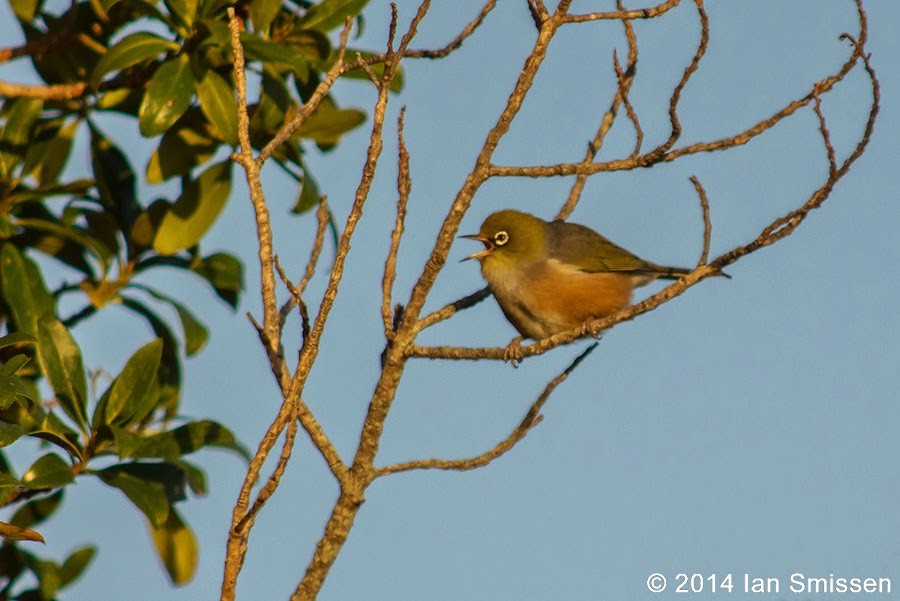
Silvereye, Pauahatanui Wildlife Reserve, NZ
New Zealand Fantail, Pauahatanui Wildlife Reserve, NZ

There is some argument that the New Zealand Fantail (Rhipidura fuliginosa) is synonymous with the Grey Fantail (Rhipidura albiscapa) in Australia but Christidis and Bowles (2008) list them separately.

SUNDAY
Of course, with me about to leave the country, the weather was glorious - sunny, warm and very little wind - but I wasn't flying out of Wellington until Sunday afternoon so I spent the morning checking out the spectacular south coast of Wellington, particularly around Island Bay

Island Bay, Wellington, NZ

where cormorants (known locally as shags), gulls and oystercatchers dominate the rocky and sandy shoreline.

Southern Black-backed Gull (= Kelp Gull) 1st and 2nd year immatures
Island Bay, Wellington, NZ
Pied Shag (= Pied Cormorant)
Island Bay, Wellington, NZ
Variable Oystercatcher
Island Bay, Wellington, NZ

I also took the scenic drive around the Miramar Peninsula, east of Wellington Airport, and finally managed to spot a Tui (an endemic NZ honeyeater). I'd been hearing what I was assuming were Tui in various places for the last two days but they had proven very difficult to spot. It must have been the better weather that brought this one out (almost) into the open.

Tui, Miramar Peninsula, Wellington, NZ

and the final bird for the weekend was a close-up view of this New Zealand Kingfisher (a subspecies of the Sacred Kingfisher found across Australia, New Caledonia, Lord Howe, Norfolk and Kermadec Islands).

New Zealand Kingfisher (= Sacred Kingfisher)
Miramar Peninsula, Wellington, NZ

Birding and Natural History Blogs - Australia

Birding Blogs - Worldwide