Showing posts with label Willie Wagtail. Show all posts

Sunday, 23 August 2015

A Morning on the Gold Coast - Part 2: Emerald Lakes

After somewhat sparse experiences at Coomera and Coombabah Lakes Mangroves, I headed for Emerald Lakes in Carrara and was not disappointed. An hour walk around the lake on the corner of Birmingham and Nielsens Roads provided a great array of the usual suspects:

Dusky Moorhen, Emerald Lakes, Carrara, Queensland
Pentax K-3, Sigma 300mm f/2.8 (x2 adaptor), ISO 400, f/8, 1/640
Eurasian Coot, Emerald Lakes, Carrara, Queensland
Pentax K-3, Sigma 300mm f/2.8 (x2 adaptor), ISO 400, f/8, 1/640
Hardhead, Emerald Lakes, Carrara, Queensland
Pentax K-3, Sigma 300mm f/2.8 (x2 adaptor), ISO 400, f/8, 1/640
Intermediate Egret, Emerald Lakes, Carrara, Queensland
Pentax K-3, Sigma 300mm f/2.8 (x2 adaptor), ISO 400, f/8, 1/800
Little Egret, Emerald Lakes, Carrara, Queensland
Pentax K-3, Sigma 300mm f/2.8 (x2 adaptor), ISO 400, f/5.6, 1/400 
Pacific Black Duck, Emerald Lakes, Carrara, Queensland
Pentax K-3, Sigma 300mm f/2.8 (x2 adaptor), ISO 400, f/8, 1/400
Purple Swamphen, Emerald Lakes, Carrara, Queensland
Pentax K-3, Sigma 300mm f/2.8 (x2 adaptor), ISO 400, f/8, 1/250
Royal Spoonbill, Emerald Lakes, Carrara, Queensland
Pentax K-3, Sigma 300mm f/2.8 (x2 adaptor), ISO 400, f/5.6, 1/500
Royal Spoonbill, Emerald Lakes, Carrara, Queensland
Pentax K-3, Sigma 300mm f/2.8 (x2 adaptor), ISO 400, f/5.6, 1/640
Royal Spoonbill, Emerald Lakes, Carrara, Queensland
Pentax K-3, Sigma 300mm f/2.8 (x2 adaptor), ISO 400, f/5.6, 1/500
Willie Wagtail, Emerald Lakes, Carrara, Queensland
Pentax K-3, Sigma 300mm f/2.8 (x2 adaptor), ISO 400, f/5.6, 1/500

...but, for a southerner, who doesn't get to see them very often, this flock of Magpie Geese was the highlight.

Magpie Goose, Emerald Lakes, Carrara, Queensland
Pentax K-3, Sigma 300mm f/2.8 (x2 adaptor), ISO 400, f/11, 1/160
Magpie Goose, Emerald Lakes, Carrara, Queensland
Pentax K-3, Sigma 300mm f/2.8 (x2 adaptor), ISO 400, f/11, 1/250
Magpie Goose, Emerald Lakes, Carrara, Queensland
Pentax K-3, Sigma 300mm f/2.8 (x2 adaptor), ISO 400, f/8, 1/400
Magpie Goose, Emerald Lakes, Carrara, Queensland
Pentax K-3, Sigma 300mm f/2.8 (x2 adaptor), ISO 400, f/5.6, 1/800

Even this Royal Spoonbill seemed to appreciate the show!

Magpie Goose + Royal Spoonbill, Emerald Lakes, Carrara, Queensland
Pentax K-3, Sigma 300mm f/2.8 (x2 adaptor), ISO 400, f/11, 1/250

Saturday, 17 May 2014

Mornington Peninsula

I spent another great day out with the Birdlife Australia Melbourne Photography group today, covering various sights on the Mornington Peninsula. First stop at Cape Schanck meant an early rise to catch the ferry from Queenscliff to Sorrento. The sun was rising as the ferry departed Queenscliff, providing some great views of Port Phillip Bay.

Sunrise over Swan Island and Port Phillip Bay

This trip frequently gives good views of several species of seabirds (including Australasian Gannets that breed on nearby Popes Eye and several channel markers in the south of Port Phillip Bay) as well as fur seals and dolphins but I was a little early for much wildlife activity this morning. However, I did manage to catch a few sleeping Little Pied Cormorants as the ferry passed by a channel light.

Little Pied Cormorant, Port Phillip Bay

I got to Cape Schanck before the scheduled meeting time so took the loop walk that gives great views of Bushranger Bay, Cape Schanck and the lighthouse.


Bushranger Bay from Cape Schanck
Cape Schanck
Cape Schanck Lighthouse

The strong N-W wind made it a tough day for birding. We did manage to find more than 20 species of birds in an hour, including Shy and Black-browed Albatross (cruising past the Cape several hundred metres offshore), Pacific, Kelp and Silver Gull and a range of bush birds but none was willing to brave the wind to give us any worthwhile photographic moments. This Shy Albatross was about as close as any got while we were there.

Shy Albatross, Cape Schanck

Next stop was the ocean Beach at Flinders where, again, the windy conditions kept the birdlife scarce but made for some interesting seascape opportunities.

Ocean Beach, Flinders

A small flock of the ubiquitous Silver Gull made interesting photographic subjects floating on the waves just offshore. I wanted to try and get all the birds in focus so closed the aperture down to f/8 (effectively f/16 as I was using the 2x teleconverter). This made the shutter speed very slow (1/25th of a second - almost impossible to shoot moving birds at this speed) so I bumped up the ISO to 1600, which gave me a shutter speed of 1/100th--not ideal but the best I could do.

Silver Gull, Flinders

This Willie Wagtail entertained several of us for about 20 minutes, allowing very close approach of up to ten photographers while it hunted for small invertebrates amongst the seaweed along the edge of the dunes. The dull light and a fast-moving bird made photographing in the natural light challenging due to slow shutter speeds so I took the opportunity to practice some more flash photography. The best images resulted from using manual flash and dropping the power down to 1/8th. The lower power makes for a very fast flash which freezes the action and also makes it easier to balance the flash with the natural light reducing the shadows.

Willie Wagtail, Flinders

After a picnic lunch, on the more sheltered jetty side of Flinders, we headed to Green's Bush (part of the Mornington Peninsula National Park see Parknotes) and took the Circuit Track from Baldry's Crossing Picnic Area. This walk passes through a stringy bark forest with dense undergrowth providing great habitat for a wide range of bushbirds.


Green's Bush, Mornington Peninsula National Park

Forests are always challenging habitats for bird photography as the canopy cuts much of the natural sunlight and many of the birds are high in the trees so they are a long way up and are nearly always silhouetted against a bright background sky. That said, with patience, you can usually locate a range of birds that will eventually become more photographic. My favourite strategy is to walk slowly along the track listening and looking for movement, until I find a suitable location to sit or stand and wait for the birds to come to me. This is harder to do in a large group but we did see more than 20 species in an hour walk. My photographic highlights were...

Eastern Yellow Robin
Green's Bush, Morning Peninsula National Park
Fan-tailed Cuckoo
Green's Bush, Mornington Peninsula National Park

After a final bird count for the day, we parted company and went our separate ways, in my case heading back to Sorrento for the return ferry trip.

...but wait, there's more...

Friday, 11 October 2013

Cairns Pioneer Cemetery

We were given a tip about a pair of Brahminy Kites nesting in a tree in the Cairns Pioneer Cemetery. When we got back from our day at Kuranda there was about an hour of light left so I decided to go and investigate.

On arrival I counted five Bush Stone-curlew skulking around the graves.

Bush Stone-curlew, Pioneer Cemetery, Cairns Qld

More intriguing was the interaction between a Laughing Kookaburra, perched on a low branch and a Willie Wagtail that clearly objected to it being there.

Laughing Kookaburra + Willie Wagtail, Pioneer Cemetery, Cairns Qld

The Kookaburra refused to fly away and the Willie Wagtail persisted for at least 20 minutes giving me time for a range of shots. Mostly this is just luck as the action happens so quickly you just have to try and predict when things will happen and fire off a short burst, hoping to catch something interesting.

Having seen enough of this, and with the light fading, I went off in search of the kite nest, soon finding it in a fork of a large pine tree. One bird was sitting on the next, almost totally obscured from sight.

Brahminy Kite, Pioneer Cemetery, Cairns Qld

As I walked around the tree looking for a better viewing angle, a pair of Pied Imperial Pigeons landed in a palm nearby.

Pied Imperial Pigeon, Pioineer Cemetery, Cairns Qld

Just as the sun was setting and clouds came over the western sky, the second kite landed on a dead branch at the top of the nest tree. It was so dark, I popped the flash on to brighten up the bird.

Brahminy Kite, Pioneer Cemetery, Cairns Qld

Almost immediately, a Magpie Lark that had previously been feeding on the ground at the base of the tree, did it's best to discourage the kite from staying.

Brahminy Kite + Magpie Lark,
Pioneer Cemetery, Cairns Qld

As with the Kookaburra and Willie Wagtail, this interaction went on for some time with neither giving in.

Saturday, 5 October 2013

Tyto Wetlands (Part 2)

...more birds from Tyto Wetlands (see Part 1)

I was lucky enough to capture a basking freshwater turtle and a male Australian Darter in the one image.

Australasian Darter, Tyto Wetlands, Ingham Qld

After the turtle departed, the Darter remained, in all his glory.

Australasian Darter, Tyto Wetlands, Ingham Qld

Comb-crested Jacanas were seen in several places and this one allowed close approach while it hunted among the lily pads.

Comb-crested Jacana, Tyto Wetlands, Ingham Qld

Red-winged Fairy-wrens were seen in many places but their perpetual motion and proclivity for remaining in the centre of bushes made them difficult to photograph.

Red-backed Fairy-wren (male), Tyto Wetlands, Ingham Qld
Red-backed Fairy-wren (female), Tyto Wetlands, Ingham Qld

Both Varied Triller and White-winged Triller calls were heard and this male White-winged Triller in breeding plumage cooperated nicely for some close-ups.

White-winged Triller (male), Tyto Wetlands, Ingham Qld

Willie Wagtails were seemingly everywhere and this one posed nicely so I couldn't resist a quick snap.

Willie Wagtail, Tyto Wetlands, Ingham Qld

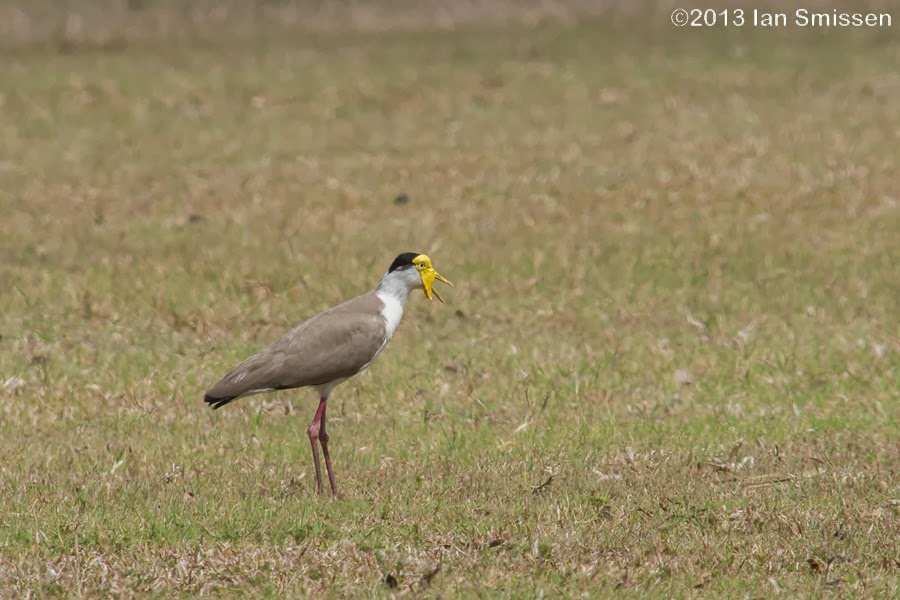
Several pairs of Masked Lapwings had small chicks and this adult was captured uttering the "duck and cover" call.

Masked Lapwing, Tyto Wetlands, Ingham Qld

Pied Currawongs could be heard in many places around the wetlands but it wasn't until I was back in the car park that I managed to find one close enough to photograph and, in this case, I almost had too much lens needing to take several steps backwards to get the whole bird in the frame.

Pied Currawong, Tyto Wetlands, Ingham Qld

Birding and Natural History Blogs - Australia

Birding Blogs - Worldwide